

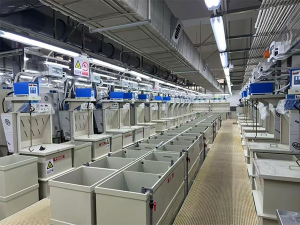
Anodizing equipment serves as a core tool in metal surface treatment. Utilizing electrochemical principles, it generates a dense oxide film on metal surfaces such as aluminum alloys, enhancing corrosion resistance, wear resistance, and decorative properties. This technology finds extensive application in aerospace, automotive manufacturing, electronic components, and architectural decoration industries, particularly suited for scenarios demanding stringent surface performance requirements.
I. Technical Principles and Core Components
The core principle of anodizing equipment relies on electrolytic reactions: aluminum alloy workpieces serve as anodes immersed in acidic electrolytes (e.g., sulfuric acid, chromic acid). When direct current is applied, oxidation reactions occur on the metal surface, forming a controllable-thickness oxide layer. The equipment primarily consists of a power supply system, electrolytic cell, cooling system, conductive assembly, and automated control system. The power supply delivers stable voltage (typically 380V) to ensure uniform oxide film growth. The electrolytic cell is constructed from corrosion-resistant stainless steel. The cooling system maintains stable electrolyte temperature, preventing localized overheating that could compromise film quality. The automated control module precisely regulates parameters like current density and oxidation time, enabling standardized processes.
II. Operational Process and Key Parameters
The operational process is divided into three stages: pretreatment, oxidation treatment, and post-treatment. Pretreatment includes steps such as cleaning, alkaline etching, and acid washing to remove oil, scale, and impurities from the workpiece surface, ensuring adhesion of the oxide film. During oxidation treatment, the workpiece is immersed in the electrolyte. By adjusting the current density (typically 1-3 A/dm²) and oxidation time (10-60 minutes), the film thickness (5-30 μm) is controlled. Post-treatment involves processes like sealing and dyeing. Sealing closes the pores in the oxide film to enhance corrosion resistance, while dyeing provides the workpiece with diverse colors. The equipment supports customized design, allowing adjustment of electrolytic tank capacity and automation levels based on workpiece dimensions and production volume requirements to accommodate different production scales.
III. Technical Advantages and Application Scenarios:
Compared to traditional chemical oxidation, the oxide film produced by anodizing exhibits high hardness (up to 500 HV or higher), excellent wear resistance, and strong adhesion to the substrate, minimizing peeling. Its corrosion resistance significantly outperforms bare metal, withstanding neutral salt spray tests exceeding 1000 hours. Constructed from stainless steel, the equipment ensures an electrolytic tank lifespan of over 10 years, reducing long-term operational costs. Application scenarios span high-value-added products such as aluminum alloy doors and windows, smartphone mid-frames, and automotive wheels. For instance, smartphone mid-frames achieve a metallic finish and anti-fingerprint properties through anodizing, while treated automotive wheels exhibit threefold improved salt spray resistance. Additionally, the equipment supports advanced processes like micro-arc oxidation to generate thicker ceramic coatings, meeting demands in extreme environments.