

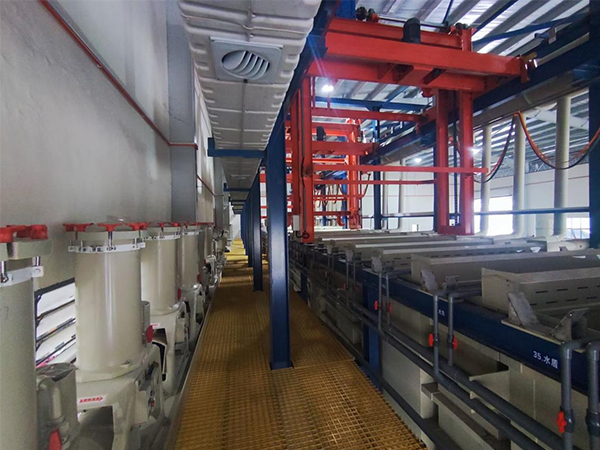
Selecting a suitable plating line requires comprehensive evaluation based on four core aspects: defining production requirements, matching workpiece types, verifying key selection indicators and assessing cost performance. The detailed analysis is as follows:
I. Define Production Requirements
Small-batch and multi-variety production
A manual plating line is the preferred choice. It features flexible layout and small footprint. Its initial investment is only 1/5 to 1/3 of that of an automated line, with no high expenditure on automated equipment. It has low requirements for workshop space and operator skills, and allows quick switching between different plating processes and workpieces, making it ideal for customized orders.
Medium and small-batch production
A semi-automatic plating line is recommended. Workpieces are transported via rail travelling cranes, and process parameters can be preset during design. Its production load factor exceeds 85%. Balancing flexibility and productivity, it delivers stable product quality at a lower cost than fully automatic lines, offering excellent cost performance.
Mass production of single products
Opt directly for a fully automatic plating line. Integrated with PLC control systems, precision transmission units and environmental protection modules, it enables full-process automatic operation. It ensures consistent plating quality and high productivity, cuts long-term labor costs, and perfectly suits large-scale production.
II. Match Workpiece Types
Workpieces with complex shapes or large dimensions
Choose a gantry-type plating line. It imposes no restrictions on plating solutions, workpiece shapes or rack types, boasting excellent process adaptability. It is widely used for decorative chromium plating on automotive aluminum wheels and decorative plating on plastic parts.
Small and tiny parts
A gantry-type automatic barrel plating line is recommended. It supports multiple processes such as zinc plating, copper plating and nickel plating, and can switch between fully automatic and semi-automatic modes. It greatly improves productivity with reliable operation and reduces labor intensity effectively.
Strip or wire-shaped continuous profiles
Adopt a continuous / reel-to-reel plating line. It enables non-stop operation with high precision in coating thickness control, well suited for high-volume continuous production.
ABS/PC plastic workpieces
An annular vertical lifting plating line is recommended. Its synchronous operation across the whole line adapts to the production of small parts in multiple varieties and meets the special process requirements for plastic plating.
III. Verify Key Selection Indicators
Environmental compliance
Select lines equipped with built-in environmental protection modules, including integrated waste liquid treatment equipment and high-efficiency acid mist purification systems, to ensure exhaust gas and wastewater discharge meet regulatory standards. Combined with industrial ultrapure water systems and low-temperature wastewater evaporators, the lines realize water recycling, reducing energy consumption and hazardous waste disposal costs.
Full-lifecycle operation and maintenance costs
Prioritize equipment adopting PLC frequency conversion control and corrosion-resistant materials for higher durability and lower failure rates. It is advisable to choose suppliers that provide one-stop services including planning, installation and commissioning to guarantee smooth production launch.
IV. Assess Cost Performance
Initial investment
The price of a small automatic barrel plating line is generally several hundred thousand yuan. In contrast, large customized linear plating lines or nickel plating lines for electrolytic cell plates may cost several million yuan.
Long-term operating costs
Cost-effective equipment features a reasonable purchase price, along with low energy consumption, minimal maintenance costs and high production efficiency during long-term operation.