

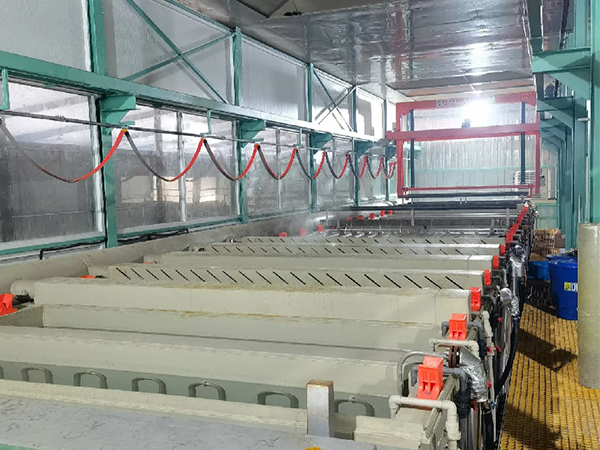
The pre-plating treatment for anodizing equipment is a critical process that determines the quality of the final anodic oxide film. Its core objective is to obtain a thoroughly oil-free, natural oxide-free, bright and uniformly conditioned aluminum substrate.
A complete pre-plating treatment process generally consists of four core procedures, supported by strict water rinsing and process parameter control:
I. Core Process Flow
1. Workpiece Hanging
Fix workpieces with special elastic fixtures to ensure stable electrical conduction. As the foundation of all subsequent processes, this step requires tight contact between fixtures and workpieces to avoid current obstruction, burn marks or workpiece falling caused by loose connection during production.
2. Degreasing
This procedure aims to completely remove residual grease and dirt generated during workpiece machining. Alkaline or acidic degreasing solutions containing surfactants are commonly used for treatment at room temperature for 3 to 5 minutes. To improve cleaning efficiency, ultrasonic cleaning technology is often adopted to ensure thorough saponification, emulsification and removal of oil contaminants.
3. Alkaline Etching
Workpieces are immersed in sodium hydroxide-based alkaline solution for uniform chemical etching. This process serves three major functions: thoroughly removing natural oxide films on the surface, eliminating stubborn oil stains remaining after degreasing, and removing minor surface scratches to form a uniform diffuse matte surface for subsequent treatment. Complexing additives such as sodium gluconate are usually added to the alkaline etching solution to inhibit the hydrolysis and precipitation of sodium aluminate, facilitating subsequent cleaning operations.
4. Desmutting
After alkaline etching, a layer of gray-black smudge composed of insoluble intermetallic compounds adheres to the workpiece surface and must be removed to achieve a clean and bright metal finish. The workpiece is typically soaked and rinsed in nitric acid or mixed acid solution at room temperature for 5 to 15 seconds. This step is also commonly known as brightening or neutralization.
II. Key Control Points and Precautions
Water rinsing is an invisible yet critical procedure throughout the whole process: Thorough water rinsing must be performed immediately after each chemical treatment (degreasing, alkaline etching, brightening) to prevent cross-contamination of chemical solutions. Notably, chloride ions in water are a major cause of pitting corrosion, so deionized water shall be used for rinsing after key processes.
Inter-process exposure time control: Workpieces after neutralization and rinsing shall not be exposed to air for an excessively long time, generally no more than 30 to 40 minutes. Otherwise, new natural oxide films will form on the surface, reducing film adhesion and even requiring rework in severe cases.
Flexible adjustment of process parameters: Pre-treatment parameters including temperature, processing time and solution concentration are not fixed. They shall be adjusted targeted according to the aluminum alloy grade, initial surface conditions (such as severe scratches and oxide scale) and final surface requirements (matte or bright finish).
In general, the pre-plating treatment for anodizing equipment is a systematic and interlinked process. Any negligence in individual procedures may result in defects including poor film formation, color difference and surface mottling in subsequent processes such as anodizing and dyeing. Therefore, great importance must be attached to this treatment process.